§ Benchmark
One question,
the two cases that decide it.
A reproducible walkthrough on a hard GDPR / AI Act question — and what semantic retrieval plus a real citation graph do that keyword search simply can’t. This is a benchmark, not a brochure: every number and query below is reproducible against the live LEX MCP.
The problem nobody talks about.
EUR-Lex is the canonical, free, authoritative home of EU law. It is also a keyword search box sitting in front of more than a million documents — so it only works when you already know the words in the document you’re hunting for. If you don’t know that the leading case on automated credit scoring is called SCHUFA, EUR-Lex will not introduce you to it. And there is no way — none — to ask it “which judgments interpret Article 22 of the GDPR?” The citation relationships exist; they just aren’t queryable.
For a human lawyer that’s a slow afternoon. For an AI agent, EU law is effectively a black box behind a search field it doesn’t know how to fill. The LEX MCP changes that: semantic retrieval at the level of individual articles, a typed citation graph exposed as structured data, all delivered over the Model Context Protocol so any agent can call it as a tool.
The test.
A fictional company — call it Aurelia — sells an AI model that produces a credit score: a probability that someone repays a loan. A bank uses Aurelia’s score to refuse an applicant, who then demands to know the logic behind the decision. Aurelia’s instinct: “we only sell a number, the bank made the decision” and “the model is a trade secret.”
Two legal axes a competent adviser has to nail:
- GDPR — is the score itself automated individual decision-making under Article 22, even though a third party (the bank) makes the final call? And must Aurelia disclose the logic involved?
- The AI Act — is credit scoring of natural persons a high-risk use case, and what obligations does that put on Aurelia as the provider?
We gave the MCP nothing but plain-language questions. No case names, no article numbers.
Without the MCP.
The honest baseline on EUR-Lex: you’d guess keywords — “automated decision credit scoring GDPR” — and skim a list ranked by literal term matching. You’d find SCHUFA only if you already knew to look for it. Having found it, you’d chase its citations by clicking through one document at a time, reconstructing by hand which later cases built on it. The trade-secret counter-argument? You’d find the case that resolves it only if you happened to search the right words on the right day.
With the MCP, part 1 — the law, by meaning, at article granularity.
We asked, in plain language, what rules govern high-risk credit-scoring AI. The semantic legislation index doesn’t return “the AI Act” as a blob — it returns the specific provisions, ranked by how well they answer the question.
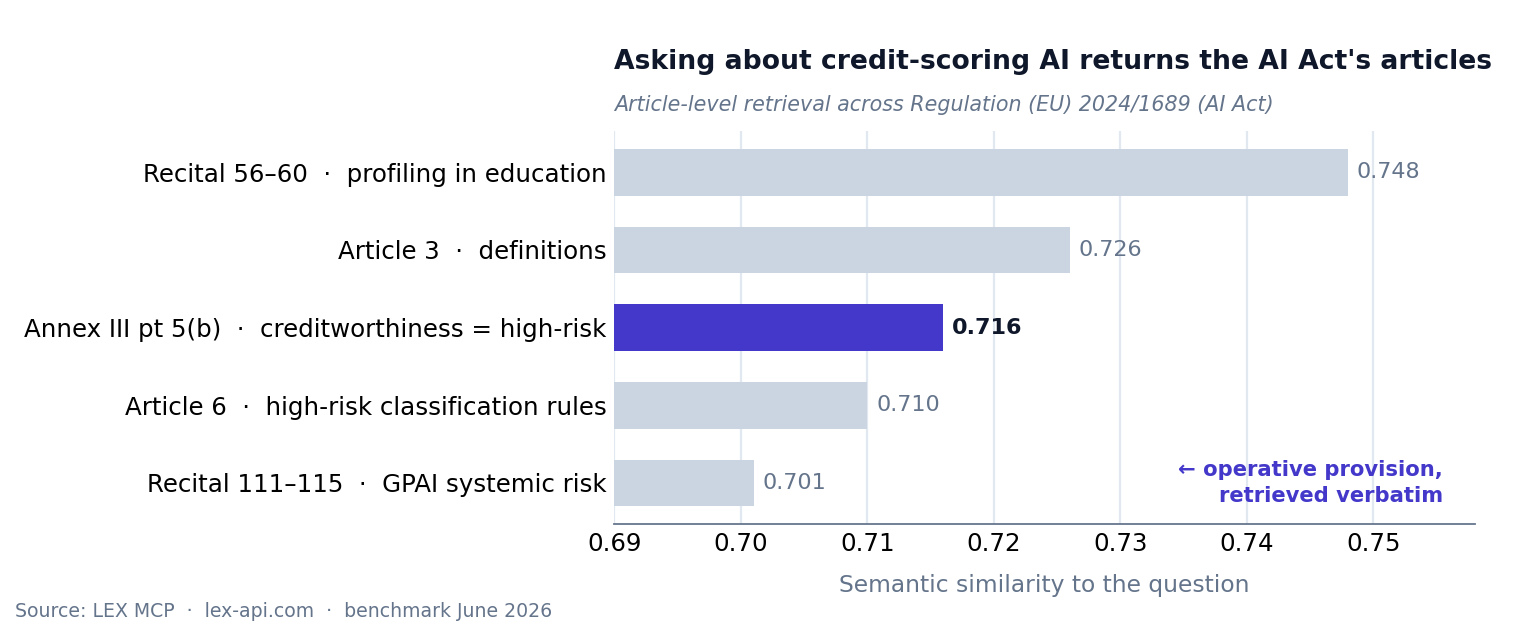
AI Act, Annex III(5)(b): “AI systems intended to be used to evaluate the creditworthiness of natural persons or establish their credit score, with the exception of AI systems used for the purpose of detecting financial fraud.”
That one line is what makes Aurelia a high-risk provider. Note the honest detail: the single highest-scoring hit is a recital about profiling in education — semantically adjacent, not operative. That’s how semantic retrieval behaves, and it’s why granularity matters — the decisive Annex III point is fully readable two rows down, instead of buried in a 144-article PDF.
Part 2 — the case law (this is the headline).
Then we asked the Article 22 question as a fact pattern — a credit agency computes a score, a bank leans on it, must the logic be disclosed — and let the case-law index rank the entire CJEU corpus by meaning.
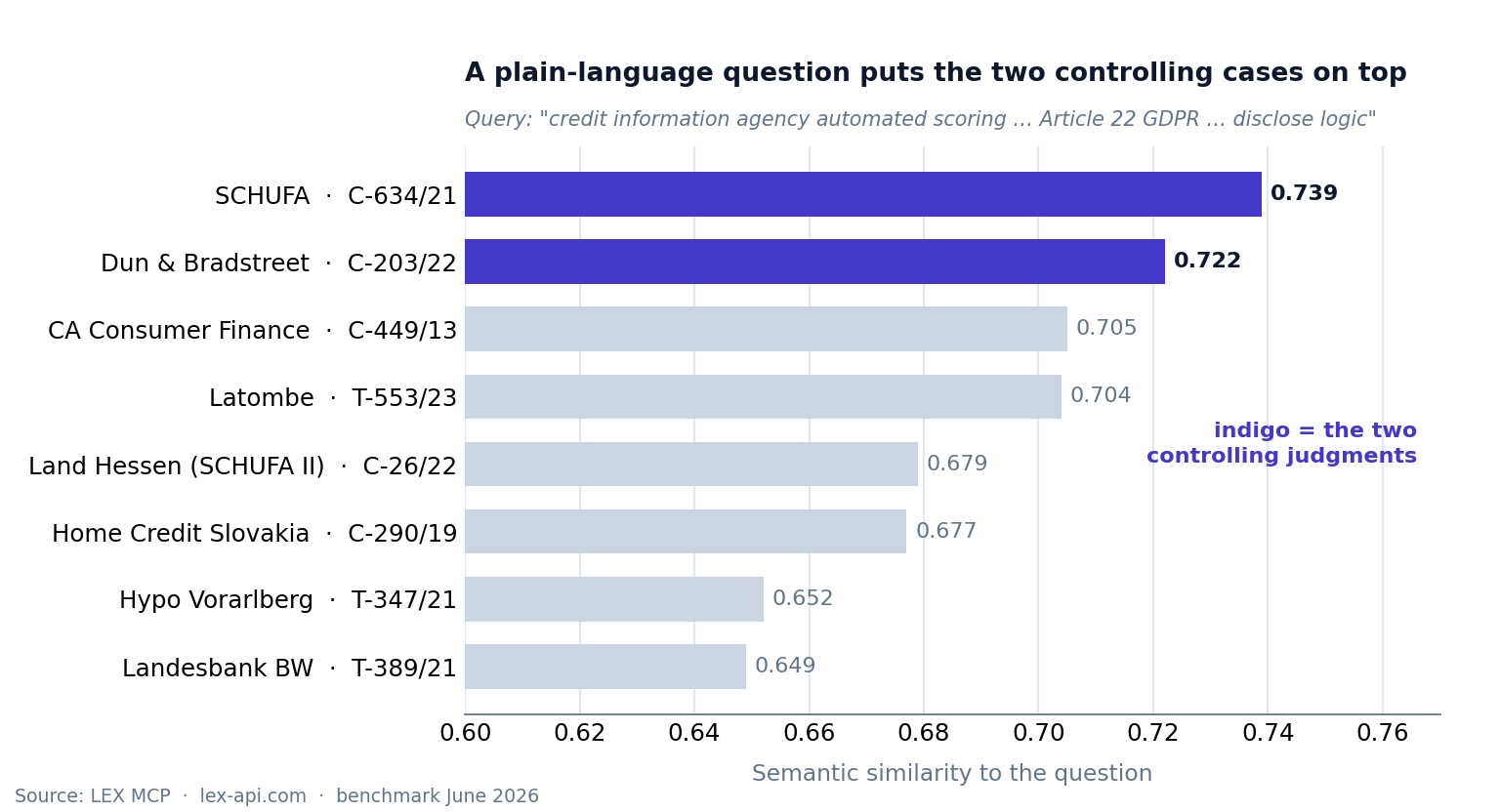
The top two results, by similarity alone, are the two judgments that control this fact pattern:
- SCHUFA (C‑634/21, 2023) held that the automated establishment of a probability value is itself an Article 22 “decision” where a third party draws strongly on it. Aurelia’s “we just sell a number” defence is dead on arrival.
- Dun & Bradstreet (C‑203/22, 2025) governs the disclosure demand: meaningful information about the logic must be provided, and a blanket trade-secret objection doesn’t cover it — the balance is struck case by case.
Here’s the part that should make you sit up. We never asked about trade secrets. Yet the corpus surfaced the one judgment that decides exactly the trade-secret-versus-disclosure fight Aurelia is about to walk into. The tool told us our opponent’s argument before we’d thought to look for it. That is the difference between a box that matches your words and a system that understands your situation.
Part 3 — the citation graph.
Knowing the leading case is half the job; a litigator needs to know what it rests on and who has built on it since. So we handed SCHUFA to the citation graph and asked for its network — one call, returned as structured data with typed edges:
Two judgments cite SCHUFA (including Dun & Bradstreet — the graph and the semantic search agree on what matters), and SCHUFA itself rests on four authorities. No clicking, no manual assembly.
Now scale it up. Point the same tool at the GDPR itself and a single call returns its entire citation network:
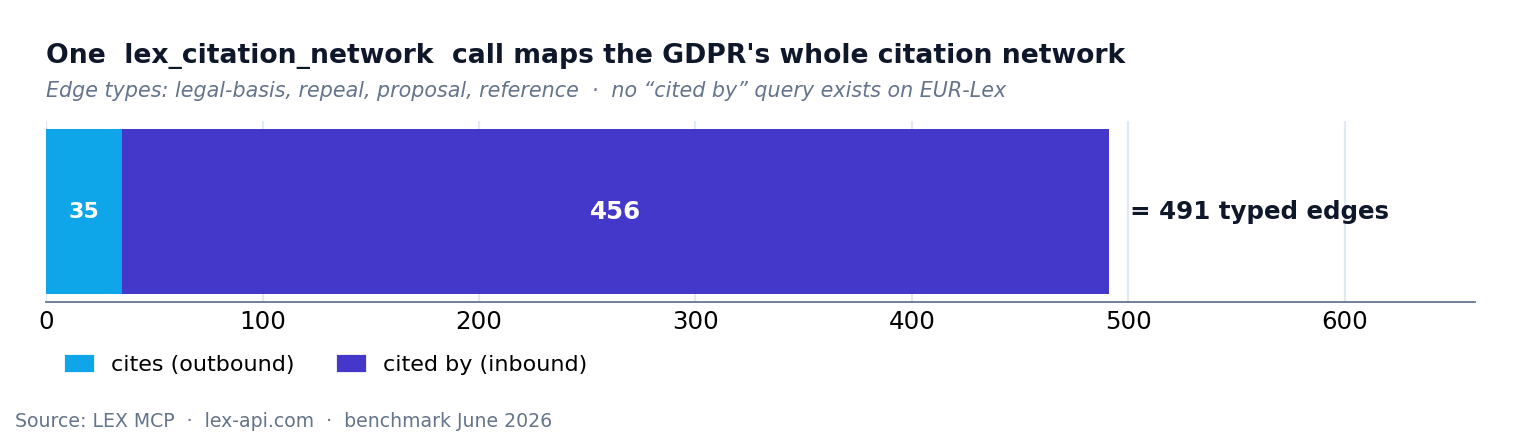
Thirty-five outbound edges and 456 inbound — every CJEU judgment, Advocate General opinion, order and Commission document that has cited the GDPR — 491 typed edges in one query. This has no equivalent on EUR-Lex, because EUR-Lex has no “cited by” query at all. It’s the closest thing to a Shepard’s or KeyCite for EU law, except it arrives as JSON an agent can traverse.
Why this is actually new.
Three specific, defensible claims — measured against EUR-Lex, the baseline everyone shares:
Concept retrieval at provision granularity. “A score from one company, acted on by another” returns Article 22 and the AI Act’s Annex III point 5(b) — the operative provisions themselves, not a list of documents to read. Keyword search cannot do this, and nothing layered on EUR-Lex’s keyword index can either.
A typed citation graph as structured data. “Every judgment interpreting the GDPR, with edge types, in one response” does not exist anywhere as an open, queryable API for EU law. This is the differentiator that’s hardest to copy.
Agent-native by construction. Because it’s an MCP server, any LLM gains EU-law research as a callable tool. The entire benchmark above ran with no user interface — not a better website, but EU legal research an autonomous agent can actually do.
The same job, with and without.
| Without the MCP (EUR-Lex) | With the LEX MCP | |
|---|---|---|
| How you search | Keyword match — you must know the document’s words | Plain-language meaning — describe the facts |
| Finding the leading case | Only if you already know it exists | Surfaces by relevance, ranked |
| Getting to the provision | Read the act, locate the point yourself | Returned at article / annex-point granularity |
| “Which cases cite this?” | No such query — manual click-through | One call, typed citation graph |
| Who can use it | A human at a browser | Any LLM agent, as a tool |
What it doesn’t do (yet).
Credibility means being straight about the edges. The keyword endpoint, lex_search, is deliberately literal — reach for it when you already know a citation or want to filter by date and type; reach for semantic search when you’re working from concepts. Corpus coverage is broad and growing, but still expanding. On the near-term roadmap: hybrid keyword-plus-semantic retrieval so terse queries rank as cleanly as full sentences; paragraph-level pinpoints so a cited case comes back at “SCHUFA, para. 73” rather than the whole judgment; and provision-level citation edges, so you can ask not just “what cites the GDPR” but “what cites Article 22 specifically.”
And the disclaimer we mean sincerely: the MCP surfaces and structures the sources. It does not give legal advice. A qualified lawyer reads what it finds and decides.
Try it — and try to break it.
Everything above is reproducible. The benchmark ran on a standard tier, fed nothing but plain-language questions, with the exact queries shown. Connect the LEX MCP to your agent, drop in the Aurelia scenario — or your own hard question — and check the results against the official sources. We’d rather you falsify this than take our word for it; that’s the whole point of publishing the numbers.
New here? The install walkthrough gets the MCP into Claude or Cursor in about thirty seconds.
Benchmark run June 2026 against the live LEX MCP. Scenario and parties are fictional; cases, provisions, and citation figures are real and current as of the run.